
Data center services, built in Utah.
Logistics, secure storage, ITAD, e-waste recycling, and facility maintenance for Utah data centers, routed to vetted providers along the Wasatch Front and counted where the community can see it.
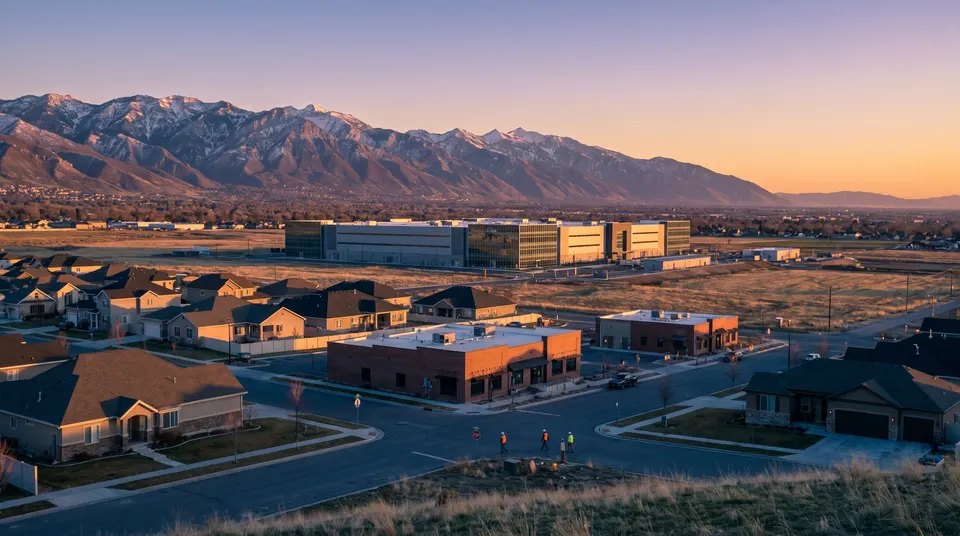
Utah stopped saying yes automatically.
In May 2026 the governor signed an executive order requiring data center proposals to be properly evaluated before they move. Within a week, one of the largest proposed campuses in Box Elder County was rescoped from roughly 40,000 acres to roughly 20,000. In August, Eagle Mountain adopted a 183 percent property tax increase, and a referendum to overturn it is underway.
None of that is an anti-growth story. It is an accounting story. Utah has no statewide ledger of what data center tax incentives cost or what they return, so every hearing relitigates the same unanswerable question. A 2026 Reuters and Ipsos poll of 4,531 Americans found only 14 percent would welcome a data center in their own community, and the reason is rarely the building. It is that nobody can show them the benefit in numbers they can check.
That is what has changed for operators here. Measured local benefit is no longer a goodwill gesture at the ribbon cutting. It is the license to operate, and it has to exist before the vote, not after.
A community that has not been shown anything votes on vibes
A community shown a promise asks who audits it
A community shown a routed dollar can check the provider by name
Every service request that stays in Utah moves a node toward filled. That notation runs across this whole site, and it is the same notation the quarterly report uses.
The corridor, not a coverage map.
Utah data center activity clusters in a handful of places. We work the whole Wasatch Front, and these are the centers of gravity that shape how work gets routed.
Salt Lake City metro
The densest concentration of enterprise IT, carrier hotels, and the freight infrastructure that serves them. Most outbound routes start or terminate here.
West Valley City
Home base. Our own address sits here, which means dispatch, escalation, and a site visit are a drive rather than a flight.
Eagle Mountain
The fastest moving campus corridor in the state, and the one where the local tax conversation is loudest. Measured local benefit matters more here than anywhere.
West Jordan
Warehousing, industrial services, and a deep bench of the trades that facility maintenance actually runs on.
Box Elder County
Where the largest proposed footprints sit, and where rural capacity has to be built rather than assumed. We verify providers here before work is routed, not after.
The wider Wasatch Front
Utah County through Davis and Weber. One corridor, one accountable partner, and a provider bench that covers it end to end.
One relationship for you. A verified bench behind it.
You hold one contract and one point of accountability. Underneath it sits a bench of Utah providers who each passed a published verification standard before they were allowed to touch an asset: insurance confirmed, credentials checked at the issuing source, certifications attributed by name, facility, and expiry.
When a request comes in, it is routed to the provider who is actually qualified for that scope in that county, not to whoever answered first. The chain of custody, the serialized documentation, and the reporting stay with us across every handoff, which is the part that falls apart when an operator manages a dozen local vendors directly.
The standard every provider passes, and the routing engine underneath it, are both published in full on the local sourcing program.
Route
Outbound work leaves your dock through one accountable partner and lands with a Utah provider instead of an out-of-state vendor.
Verify
Credentials are checked at the source, and every certification is attributed to the entity that actually holds it.
Quantify
Jobs, wages, and local spend are counted quarterly against a published methodology. How we count.
What one facility is worth to Utah when the work stays here.
A single 100MW facility with its outbound service work routed locally supports 153 annual local jobs across 12 Utah businesses, $14.1M in local wages, and $288K in operational cost reduction for the operator. That is $26.4M of annual local economic impact that currently leaves the state by default.
Illustrative model: 100MW facility.
The four we get asked first.
Do you operate a recycling or data destruction facility in Utah?
No. NexWave is not a processor. We route work to certified partner facilities and manage the chain of custody, the documentation, and the reporting around it. Sanitization and destruction are performed by the certified facility, and that facility issues the certificate under its own accreditation. If a vendor tells you it holds every certification and also owns every truck, ask which entity number the certificate is issued against.
How much of the work actually stays in Utah?
That is the number we exist to report, so we do not estimate it in a sales conversation. Every routed job carries the provider, the county, and the dollar value, and the quarterly report rolls those up with the methodology attached. Where a capability genuinely does not exist in state, the report says so by name rather than burying it in a total.
Can these numbers survive a public hearing?
They are built to. Every figure traces to a routed job with a named local provider, and the methodology is published rather than described. The illustrative model on this site is labeled as illustrative everywhere it appears, precisely because a number that cannot be sourced in a hearing is worse than no number at all.
We already have national vendors under contract. Where does NexWave fit?
Usually alongside them, not instead of them. Most operators keep a national master agreement and route the recurring outbound work, the moves, the storage, the disposition runs, and the maintenance, to a local partner who can be counted. That is the portion a community benefits agreement can point at, and it is the portion a national contract cannot make local.
More on the separation between what we do and what our partners do, on the verification standard.
Utah is deciding. Bring numbers.
We will scope an impact assessment to your Utah facility, show you which outbound work can realistically be routed in state today, and hand you the methodology with it.